

In last month’s edition of The Canadian Business Playbook, we covered how to register your business in Canada. A few readers asked a fair question: Shouldn’t you choose your legal structure before you register?
Well, yes. You absolutely should!
But that’s not how most founders think about it at first. When you’re in the early stages of starting a business, “how do I register” is usually the first thing that comes to mind. It feels like the action step. You want to make things official.
The question of which legal structure to use often doesn’t surface until you’re partway through that process – when a government form asks what kind of entity you’re registering, and you realize you don’t have a clear answer.
That’s why we covered registration first. It’s where most founders start, mentally.
This month, we go to the decision underneath it.
Your legal structure determines how your income is taxed, what personal liability you carry, whether you can raise investment, and what happens when you eventually sell. It’s the decision that should come first, and understanding it now still matters whether you’ve already registered or not.
If you haven’t read the article on “How to Register Your Business in Canada” yet, start here, then go back. The registration steps will make more sense once you know what you’re registering.
Before I finalized AIVahan’s structure, I did thorough research into current provincial requirements and modeled tax scenarios, then brought that structured analysis to my accountant as a starting point. That one step made the meeting significantly more productive. Throughout this blog, I’ll show you exactly how to do the same, and where professional advice is still essential regardless.
Get The Playbook monthly · Follow us on LinkedIn · Learn More
-
Why This Decision Has More Consequences Than It Looks
Your legal structure is one of those decisions that looks administrative but is genuinely strategic. It sets the terms for:
- Tax – How your income is taxed, at what rate, and whether you can defer it inside a corporate entity
- Liability – Whether a lawsuit, bad debt, or supplier dispute can reach your personal savings, home, or investments
- Ownership – Whether you can bring in partners, investors, or co-founders in a clean, investable way
- Exit – Whether you qualify for one of Canada’s most valuable tax shelters when you eventually sell
- Compliance – How much reporting, filing, and administration comes with your business each year
You can restructure later. But converting a sole proprietorship to a corporation after years of operation can trigger capital gains on goodwill, require contract reassignments, complicate your banking history, and cost several thousand dollars in professional fees. Getting it right from the start is significantly cheaper than fixing it later.
Important Questions to Ask Yourself Before You Choose Your Structure
The technical decision, sole proprietorship vs. corporation, should follow from a broader set of questions about what kind of business you’re building.
Most founders skip this part.
They pick a structure based on what their friend did or the first blog they read. But the right structure depends on where you’re going, not just where you’re starting.
1. What kind of business are you building?
Service businesses (consulting, coaching, marketing, legal) have different liability profiles than product businesses, which differ again from SaaS or digital products. If you’re building something physical, something that employs people, or something you’d want to sell – the structure decision matters more and earlier.
2. How do you want to run it?
Some founders want to stay lean, just them, a few clients, minimal overhead. Others want to delegate early and build systems. If you’re thinking about virtual assistants, contractors, or employees from the start, it is recommended to incorporate. A corporation makes that cleaner in every way.
3. Are you planning to bring in partners or co-founders?
If yes – Corporation with a shareholders’ agreement, non-negotiably.
Co-founding relationships without formal agreements end badly at a rate that should concern you. A handshake is a legal contract in Canada, just not one you can enforce.
4. How are you planning to fund this?
- Bootstrapping or personal savings: Sole proprietorship works short-term
- Business loans: Both structures work; many lenders prefer corporations
- Angel investors, VCs, or equity investment of any kind: Incorporate before anything else
- Grants or government programs: Check program requirements – some are restricted to incorporated entities
5. Are you thinking about going public eventually?
Even as a distant possibility, the share structure and governance decisions you make now affect that path. Getting the structure right early, if public markets are ever part of the vision, is far easier than restructuring later.
6. Will you be importing or exporting?
Cross-border transactions add complexity: customs, duties, transfer pricing, foreign account reporting. Corporations handle this more cleanly and offer more planning flexibility.
7. Are you planning to expand provincially, nationally, or internationally?
Federal incorporation gives you name protection across Canada and a cleaner path to operating in multiple provinces. If you see yourself across provincial lines within a few years, federal incorporation is worth considering from day one.
8. Do you have numbers yet?
Many founders make this decision before they’ve earned a single dollar, and that’s completely fine. The decision framework works without revenue. You’re planning for the business you’re building, not just the one you have today. A pre-revenue founder who plans to hire employees and raise investment should incorporate immediately. A pre-revenue freelancer working solo with no personal assets to protect can reasonably start as a sole proprietor and reassess.
Working through these questions before reading the structure comparisons will make the decision significantly clearer.
The Four Legal Structures Available to Canadian Entrepreneurs
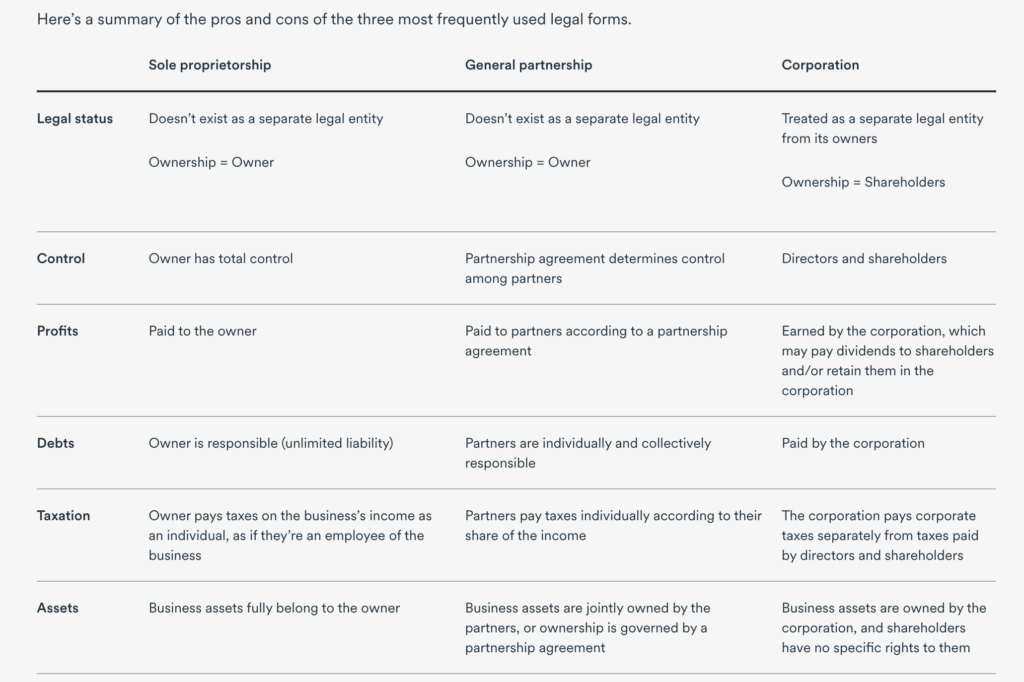
Pros and Cons of Sole Proprietorship, General Partnership and Corporation 1. Sole Proprietorship
A sole proprietorship is the default structure.
- You and your business are legally the same person.
- There’s no formal incorporation.
- You don’t create a separate legal entity.
- You are the business.
When you need to register your name:
If you operate under your own legal name (e.g., Jane Smith), many provinces don’t require business name registration. The moment you use a trade name , (eg. “Coastal Creative” or “Smith Consulting”), you’re generally required to register that name provincially.
Requirements and costs vary by province:
Province Business Name Registration Fee Validity Ontario Required for non-legal names (Ontario Business Registry) $60 5 years British Columbia Required (BC Registry) ~$40 No expiry Alberta Required (AMES / ABRegistry) ~$50 Varies Quebec Required (Registraire des entreprises) ~$39 Annual update required Saskatchewan Required ~$65 3 years Manitoba Required ~$60–$100 Varies Nova Scotia Required ~$64 Varies Newfoundland & Labrador No registration required for trade names – – Newfoundland & Labrador is the notable exception: Sole proprietors using trade names are not required to register them provincially.
How your taxes work:
All business income flows to your personal T1 income tax return via a T2125 (Statement of Business or Professional Activities). You pay personal income tax rates, plus CPP contributions on self-employment income (both employee and employer portions – currently 10.9% on net self-employment earnings up to $73,200 in 2026).
GST/HST registration is mandatory once your worldwide taxable supplies exceed $30,000 across any four consecutive calendar quarters. Below that threshold, registration is optional, though voluntarily registering early lets you claim input tax credits on business expenses.
We will go through tax registration in detail in upcoming blogs!!
Pros:
- Fastest and cheapest to set up – same day, $40–$100
- Business losses offset other personal income in the same year
- No separate corporate tax return or corporate administration
- Straightforward for banking and early-stage operations
Cons:
- Unlimited personal liability
- Creditors can come after your home, savings, and personal assets.
- There is zero legal wall between you and your business.
- Personal tax rates apply in full
- Once net income climbs above roughly $55,000–$100,000 (depending on province), you’re in steep personal marginal brackets – well above what a CCPC pays on the same income.
- Investor access is essentially closed
- Most serious financing requires a corporate structure.
- No Lifetime Capital Gains Exemption on exit
- When you sell a sole proprietorship’s assets, every dollar of capital gain is exposed at personal tax rates.
Best for: Freelancers, consultants, and early-stage solo service businesses with low liability exposure and income under ~$75,000.
2. Partnership
Two or more people carrying on business together for profit.
- Partnerships can form without any paperwork.
- The moment two people agree to share a business for profit, a legal partnership exists, verbally, even accidentally.
- That’s the first problem.
Three types of partnerships:
- General Partnership (GP): All partners share management responsibilities and carry unlimited joint and several personal liability.
- If your partner signs a catastrophic contract and the business can’t pay, creditors can come after you in full, even if you had nothing to do with it.
- Income is split per your partnership agreement (or equally by default under provincial law) and each partner reports their share on their personal T1 return.
- Limited Partnership (LP): At least one general partner (unlimited liability, manages the business) and one or more limited partners (liability capped at their investment, passive role).
- LPs are widely used in real estate syndications, private equity vehicles, film tax credit structures, and farming.
- Limited Liability Partnership (LLP): Available only to regulated professions in most provinces – lawyers, accountants, notaries, dentists, depending on province.
- Partners are shielded from each other’s malpractice, but not from their own.
One rule that overrides everything else for general partnerships:
Get a written partnership agreement before a single dollar changes hands.
It must cover profit and loss allocation, decision-making authority, capital contributions, non-compete clauses, what happens if a partner wants to leave, how buyouts are priced, and what happens in the event of death or incapacity.
A lawyer-drafted agreement costs around $500–$2,000. Not having one when a dispute arises can cost your entire share of the business.
Best for: LPs for real estate and investment structures. LLPs for regulated professional firms. For most co-founding situations, a corporation with a shareholders’ agreement is the better structure.
3. Corporation
A separate legal person, independent of its owners.
- When you incorporate, you create a new legal entity.
- This entity can own property, sign contracts, hire people, borrow money, sue and be sued, entirely separately from you personally.
- You own shares in the corporation.
- The corporation owns the business.
Federal vs. Provincial Incorporation
Your first decision when incorporating is whether to go federal under the Canada Business Corporations Act (CBCA), or incorporate provincially under your province’s legislation.
Director residency requirements vary significantly:
Jurisdiction Canadian Residency Requirement for Directors Federal (CBCA) 25% must be resident Canadians (min. 1 of 4 or fewer) British Columbia None Ontario None (requirement removed in 2021) Alberta None Quebec None Saskatchewan 25% must be resident Canadians Manitoba 25% must be resident Canadians Nova Scotia 25% must be resident Canadians New Brunswick 25% must be resident Canadians Newfoundland & Labrador 25% must be resident Canadians For non-resident founders or international teams: BC, Ontario, Alberta, and Quebec provincial corporations are the most accessible options, with no director residency requirements.
Incorporation costs by jurisdiction (2026):
Jurisdiction Government Filing Fee Name Search Estimated DIY Total Federal (CBCA) $200 online / $250 by mail $60 (NUANS) ~$260 British Columbia $350 $30 ~$380 Ontario $300 Included ~$300 Alberta $275 ~$30 ~$305 Quebec $397 Included ~$397 Saskatchewan $265 ~$60 ~$325 Manitoba $300 ~$49 ~$349 Federal corporations must also register extra-provincially in each province they operate in (typically $50–$300 per province).
Annual compliance filing costs:
Jurisdiction Annual Return Notes Federal $200 Filed with Corporations Canada British Columbia ~$44.89 Annual Report to BC Registry Ontario Free Must still be filed to maintain good standing Quebec $106 standard / $159 priority Annual Update Declaration Alberta ~$45 Annual Return Saskatchewan ~$60 Annual Return Annual compliance filing costs The Tax Advantage of Incorporating
Canadian-controlled private corporations (CCPCs) that qualify for the Small Business Deduction (SBD) pay lower tax on active business income. The SBD applies to the first $500,000 of active business income federally, with some provinces setting a higher limit.
Here are the 2026 combined federal + provincial SBD rates, from lowest to highest:
Province / Territory Prov. SBD Rate Combined Rate Business Limit Key Notes Manitoba 0% 9% $500,000 Lowest combined rate in Canada Yukon 0% 9% $500,000 Saskatchewan 1% 10% $600,000 Higher provincial business limit Prince Edward Island 1% 10% $600,000 Higher limit Nova Scotia 1.5% 10.5% $700,000 Highest business limit; 3-year tax holiday for new businesses British Columbia 2% 11% $500,000 Alberta 2% 11% $500,000 Newfoundland & Labrador 2% (2026) 11% $500,000 Rate drops to 1.5% in 2027, 1% in 2028 Northwest Territories 2% 11% $500,000 New Brunswick 2.5% 11.5% $500,000 Ontario 3.2% → 2.2% (Jul 1) 12.2% → 11.2% $500,000 Rate drops July 1, 2026 Quebec 3.2% → 2.2% 12.2% → 11.2% $500,000 Stricter SBD eligibility applies Nunavut 3% 12% $500,000 Source: TaxTips.ca – 2026 Corporate Income Tax Rates
What this means in plain terms:
A CCPC in BC earning $200,000 of active business income pays approximately $22,000 in corporate tax (11%). A sole proprietor in BC with the same $200,000 net income pays roughly $75,000–$84,000 in personal tax, depending on their specific circumstances.
Special provincial programs worth knowing
- British Columbia – Small Business Venture Capital Tax Credit
- A 30% refundable tax credit for investors who put equity into an eligible BC small business, up to $300,000 per investor.
- Only incorporated BC corporations can register as an “Eligible Business Corporation”. Sole proprietors can’t access this at all.
- Budget 2026 bumped the program’s annual cap from $38.5M to $53.5M and raised the max credit per investor from $120,000 to $300,000.
- British Columbia – Community Contribution Company (C3/CCC)
- BC-specific hybrid structure, first of its kind in Canada, sitting between a regular corporation and a nonprofit.
- Must direct at least 60% of profit to a social purpose, dividends to shareholders capped at 40%, still taxed as a regular corporation (not tax-exempt).
- British Columbia – BC Budget 2026 credits
- The BC SR&ED tax credit was made permanent, and a new Manufacturing & Processing Investment Tax Credit launched (15% of eligible investment up to $2M, max $300,000 credit).
- Both only apply to corporations.
- Nova Scotia – 3-Year Corporate Tax Holiday
- Nova Scotia offers a complete provincial corporate tax exemption for the first three taxation years of a new small business after incorporation.
- A new CCPC in Nova Scotia pays only the 9% federal rate for its first three years.
- This is one of the most underutilized incentives in Canada.
- Newfoundland & Labrador – Declining Rate
- NL is systematically reducing its small business rate: 2% in 2026, 1.5% in 2027, 1% in 2028.
- The tax environment there is improving if you’re operating in or considering NL.
- Quebec – Extra SBD Eligibility Requirements
- Quebec has stricter eligibility criteria for its provincial small business deduction.
- If you’re operating in Quebec, confirm SBD eligibility with a Quebec-licensed CPA.
- Saskatchewan & PEI – Higher Business Limit
- Both provinces have a $600,000 provincial business limit (vs. the federal $500,000).
- Saskatchewan locked in its 1% SBD rate through a December 2024 budget decision.
Tax deferral – the compounding advantage
Lifetime Capital Gains Exemption (LCGE):
When you sell the shares of a Qualified Small Business Corporation (QSBC), you may shelter up to $1,275,000 in capital gains from tax in 2026, indexed annually for inflation. The capital gains inclusion rate remains 50% in 2026 – the proposed increase to 66.67% was cancelled in March 2025.
- The corporation must be a CCPC at the time of sale
- At least 90% of the fair market value of assets must be used in active Canadian business at time of sale
- At least 50% of assets must have been used in active business throughout the 24 months preceding the sale
- Shares must have been owned continuously by the seller for at least 24 months
The LCGE does not exist for sole proprietors. Asset sales from a sole proprietorship are fully exposed to personal capital gains tax.
Two traps that generally catch incorporated founders off guard
- Personal Services Business (PSB) rules
- If your corporation provides services to a small number of clients and the CRA determines you’d effectively be an employee if the corporation didn’t exist, your corporation may be classified as a PSB, taxed at around 33% federally and ineligible for the SBD.
- Discuss with a tax accountant before incorporating if this applies to you.
- Director liability
- The corporate shield is real but not absolute.
- Directors are personally liable for unremitted payroll source deductions (CPP, EI, income tax withheld from employees), unremitted GST/HST, and certain environmental obligations.
- Set up remittances correctly from day one.
- Work with a tax professional to ensure compliance.
4. Co-operative
A member-owned, democratically-governed enterprise.
Co-operatives incorporate under separate federal or provincial co-operative legislation and operate on democratic principles – one member, one vote, regardless of financial stake. Surplus is returned to members as patronage refunds based on use, not shareholding.
Common forms:
- Worker co-ops
- Agricultural co-ops
- Consumer co-ops
- Credit unions
- Housing co-ops
- Childcare centres
Co-operative legislation, tax treatment, and governance requirements vary significantly by province. Federal co-operatives incorporate under the Canada Cooperatives Act. If you’re considering a co-op structure, start with a co-operative development organization in your province.
Best for: Community enterprises, worker-owned businesses, and social enterprises where democratic governance and member benefit are the structural purpose.
The Legal Structure Decision Framework™
Answer these 6 questions:
Q1: Do you have personal assets worth protecting?
A home, RRSP savings, investments, a vehicle – anything a creditor could seize. If yes: incorporate. The liability shield justifies it on its own.
Q2: What is your realistic net income this year?
- Under $50,000 net: Sole proprietorship is defensible. Tax savings may not yet cover corporate admin costs.
- $50,000–$100,000: Run the numbers with a CPA. Incorporation often makes sense in this range.
- $100,000+: Incorporate. Tax deferral savings will typically exceed accounting fees.
- $500,000+: Incorporate immediately. Plan your compensation structure with a CPA from day one.
Net income = after expenses. A contractor billing $150,000 with $80,000 in deductible expenses has $70,000 net which is a different calculation from a consultant billing $150,000 with minimal costs.
Q3: Are you starting this with anyone else?
If yes: Corporation + shareholders’ agreement. A general partnership exposes you to your partner’s individual decisions and debts. A shareholders’ agreement sets the rules before emotions run high.
Q4: How risky is your industry?
Construction, food service, healthcare, childcare, physical retail, professional services with client-facing exposure, any business involving employees or physical premises – incorporate. One lawsuit without a corporate shield can be financially devastating.
Q5: Are you planning to raise investment or sell the business in the next 10 years?
If yes to either: incorporate now. Investors expect corporations. And the LCGE ($1,275,000 in 2026) requires that you own qualifying shares, with the clock starting from the date of incorporation.
Q6: How much administrative overhead can you realistically carry right now?
A corporation means an annual T2 corporate return, a corporate minute book, annual government filings, and clean separation of personal and business finances. Starting as a sole proprietor in year one and incorporating when income justifies professional support is legitimate – if your liability risk is genuinely low and you have few personal assets to protect.
This framework is also available as a companion worksheet. Download it, fill in your answers, and land on one clear answer to bring to your CPA or lawyer.
Cost Comparison for All Legal Structures
Sole Proprietorship General Partnership Corporation Initial setup $40–$100 (name registration) $40–$100 + $500–$2,000 (partnership agreement) $260–$400 (DIY) / $1,500–$4,000 (with legal advice) Annual tax filing T1 + T2125 (~$300–$800) Each partner files T1 personally T2 corporate return ($1,000–$3,000+ accountant) Annual government filings None Varies $0–$200 depending on jurisdiction Estimated Year 1 all-in $400–$1,000 $700–$3,000 $1,800–$6,000 Tax on $200K net income (BC) ~$75,000–$84,000 personal ~$75,000–$84,000 per partner’s share ~$22,000 (11% CCPC SBD) Common Mistakes Founders Make

Incorporating without a shareholders’ agreement
The corporation gives you the structure. The shareholders’ agreement gives you the rules. Without it, there’s no process for a co-founder exit, a dispute, or a change in circumstances.
Confusing business name registration with incorporation
Registering “Maple Tech” in Ontario gives you the right to use that name in Ontario. It does not create a separate legal entity, does not limit personal liability, and does not change how you’re taxed.
Not revisiting the decision as income grows
The optimal structure at $40,000 is often different at $250,000. Review with your accountant annually.
Ignoring Director Liability
You remain personally liable for unremitted payroll deductions and GST/HST even inside a corporation. Set up remittances correctly from the start.
Falling into the Personal Services Business trap
If you incorporate as a consultant primarily serving one client, the CRA may classify your corporation as a PSB – 33% federal rate, no SBD, limited expense deductions.
Starting a general partnership with a handshake
A verbal agreement is a legal contract in Canada. It is nearly impossible to enforce without documentation. Get a written partnership agreement before day one.
Mixing personal and business finances
Open a dedicated business bank account from day one. Commingling funds weakens the corporate liability shield, creates audit risk, and makes year-end accounting more expensive.
Staying a sole proprietor past the inflection point
Roughly $75,000–$100,000 net is where the tax savings of incorporating typically pay for the accountant in year one.
Some Tools You Can Use at This Stage
Getting your legal structure right requires a few specific tools and some professional support. Here are some tools worth checking out:
For incorporation:
Ownr – (What I used to register AIVahan – and still use): ownr.ca
- Provincial registration: ~$99
- Federal registration: ~$299
- Includes legal documents, name clearance, and filing
- Timeline: 5-10 business days
- Full transparency: I use Ownr for filing AIVahan’s annual requirements and genuinely love it. That’s why I’m recommending it with a referral link. I only recommend tools I actually use and believe in.
- Use my referral link (it helps support this blog)
For document management:
Foxit PDF Editor – Foxit PDF Editor enables quick and easy creation of professional looking PDF documents, securely eSign documents and protect sensitive information. It is a reliable PDF tool that handles the volume of PDFs like government forms, directors’ resolutions, banking agreements, and supplier contracts.
For banking:
Open a dedicated business bank account before your first transaction. In Canada: TD, RBC, BMO, Scotiabank, and CIBC all have small business accounts. EQ Bank and Wealthsimple Cash work for digital-first operations. The specific bank matters less than having a clean separation between personal and business money from day one. We will go through more financing options in later blogs and newsletters.
For professional advice:
Budget for a 60-minute consultation each with a Canadian CPA and a Canadian business lawyer before you finalize your structure. Combined cost: typically $400–$1,000. That conversation, properly prepared for, will pay for itself in year one.
For operations and workflow automation:
As a founder, you want to be AI-ready from day one. After setting up your legal and financial foundation, the next layer is building smarter operations, from compliance reminders and client intake to inbox management and repetitive workflows.
IBM WatsonX Orchestrate is a no-code AI agent platform that helps founders create their own AI assistants and automate workflows without needing to hire a developer.
As an IBM Silver Business Partner with WatsonX expertise, AIVahan helps entrepreneurs understand and apply AI agents in practical business scenarios, whether through custom AI solutions or hands-on IBM watsonx Orchestrate workshops designed for founders. We’ll explore in more detail how to build custom AI agents in future editions of The Canadian Business Playbook.
If you want to start building your AI-powered workflows sooner, schedule an appointment with our experts here.
Connect with Shreya on LinkedIn or reach us at aivahan.com.
What Comes Next
With your legal structure decided, you’re ready to register. That’s what Month 1 of The Playbook covers – the registration process for each structure, from provincial name registration to federal CBCA incorporations to CRA program accounts (GST/HST, payroll, corporate income tax).
Month 3 of The Playbook will cover what comes after both decisions: building the financial infrastructure your business needs to operate: business bank accounts, CRA program accounts, bookkeeping systems, and the financial hygiene that protects your liability shield and keeps you out of trouble at tax time.
Have Questions?
What part of this decision feels unclear? Drop a comment below – I read them all and answer directly. Or connect with me on LinkedIn.
Stay Connected with AIVahan International
The Playbook publishes monthly – practical, researched, and designed to help Canadian entrepreneurs build their businesses with clarity and confidence.
- LinkedIn (Company): AIVahan International
- LinkedIn (Personal): Shreya Gupta
- Instagram: @aivahan_international
- Medium: Shreya Gupta on Medium
- Website & Services: aivahan.com
This post is for informational purposes only and does not constitute legal or tax advice. Tax rates, legislation, and registration requirements are current as of July 2026 and subject to change. Always consult a qualified Canadian lawyer and CPA for advice specific to your situation, province, and personal circumstances.
References
- Government of Canada – Change of legal status (CRA)
- Government of Canada – Registering a sole proprietorship or partnership
- Business Name Registration Canada 2026 – SmartSMSSolutions
- Government of Canada – Sole Proprietorship (CRA)
- Government of Canada – GST/HST for Businesses
- Government of Canada – Registering a Partnership
- LawDepot – Provincial and Federal Incorporation in Canada
- Government of Canada – Incorporating a Federal Business
- Federal vs. Provincial Incorporation 2026 – MinuteBox
- Director Residency Requirements by Province – Canada Director
- Canada Incorporation Fees 2026 – 2727 Coworking
- Government of Canada – Corporation Tax Rates
- TaxTips.ca – 2026 Corporate Income Tax Rates
- Nova Scotia – New Small Business Tax Deduction
- Lifetime Capital Gains Exemption $1.275M (2026) – Insight Accounting CPA
- Small Business Deduction and PSB rules – TaxPage
- BC Government Small Business Venture Capital Program
Next Step: See How AI Can Work for You
You’ve seen what we offer – now see how it can make a real difference for your organization.
Whether you need a strategic AI roadmap, secure implementation, team training, or ongoing support, we’ll help you take the next step safely, efficiently, and with measurable results.No jargon. No guesswork. Just clear, practical guidance for your business or institution.
Leave a Reply